Last night, I found myself lying awake thinking about something. What if we’ve made change a much bigger thing than it needs to be?
Not change itself. Change is inevitable. It’s how we grow, improve and move forward. I’m talking about the enormous machinery we’ve built around it.
Think about Agile. DevOps. Cloud. And now AI. Each arrives with its own programme, communication strategy, change champions, adoption milestones, awareness campaigns and dashboards. We’ve become exceptionally good at managing the process of change. But have we unconsciously now made change something to fear?
The question kept widening. What started as a frustration with transformation programmes (including the week Steerco report updates and Excel tracking sheets) became something about identity, conformity, the environments we create and, most importantly, the things that don’t change at all.
Is change really a separate thing, or simply the work?
Why do we treat every evolution in how we work as a transformation programme? When we introduced Agile, we taught ceremonies. With cloud, we created cloud transformation programmes. With AI, everyone needs a use case, a token budget, and proof of adoption.
But work has always evolved. New tools emerge, better practices become possible and expectations change. Why can’t that evolution be part of the work?
There is an uncomfortable counterpoint to this: not everyone is equally equipped to adapt. Some need time, support and reassurance. Others fear their skills or roles are becoming irrelevant. Without deliberate help, the confident move forward and others get left behind.
Fair point. But I wasn’t suggesting we remove support. I was questioning why supporting people through change had become synonymous with creating an entire programme around it. There is a difference between helping someone adapt and making them feel they are being transformed.
Perhaps the change isn’t sudden. The conformity pressure is.
AI hasn’t appeared overnight. Many people have already been experimenting with it, at home and at work. Yet organisations often introduce it as if everyone is encountering it for the first time. Suddenly there’s a programme, a deadline, a business case and an expectation to demonstrate adoption.
The distinction that stopped me was this: perhaps the change isn’t sudden. Perhaps the conformity pressure is.
Maybe people aren’t resisting AI, cloud or Agile. Maybe they’re resisting being told exactly how and when to demonstrate adoption. “Here’s a capability that can help you” is different from “Prove you’ve adopted this capability by Friday.” One creates opportunity; the other creates an obligation to perform change.
What if change happened through people, rather than to them?
I thought about pregnancy. For a mother carrying a baby, the transition to parenthood is often a gradual physical experience. Your body, routines and expectations evolve. A father or non-carrying parent may prepare too, but not experience that same physical progression. When the baby comes home, the practical reality can feel much more sudden.
The point isn’t the nine months. It’s participation. Is change something happening to you, or something happening through you?
Perhaps too many workplace transformations are designed around the former. We announce, explain, programme and measure. What if people instead experienced evolution through everyday work? Gradual change can still be disruptive and frightening. Maybe the goal isn’t to hide change, but to stop making it feel imposed.
Are we demanding conformity in the wrong place?
In regulated organisations, consistency matters. We need security, governance and responsible boundaries for AI. But that doesn’t mean prescribing everyone’s adoption journey.
What if conformity existed primarily in the capabilities we provide, rather than the behaviours we prescribe? In the case of AI, that could mean putting as much energy into the harness around the model as we put into the adoption programme: secure access, sensible permissions and guardrails, integration into the tools where work already happens, and token economics that make regular use affordable. Remove friction. Make safe choices intuitive. Give people the opportunity to discover what they can achieve while doing the work itself. I will explore some of those conditions in a follow-up.
Behavioural standards still matter. People must develop skills and exercise judgement. But establishing boundaries is different from demanding that everyone transform on the same schedule.
What if we stopped trying to make people fit a new operating model and instead evolved the operating environment so people could grow into it? The organisation creates the conditions; leaders help people navigate; individuals take responsibility for learning.
You’re still a student. The school has changed.
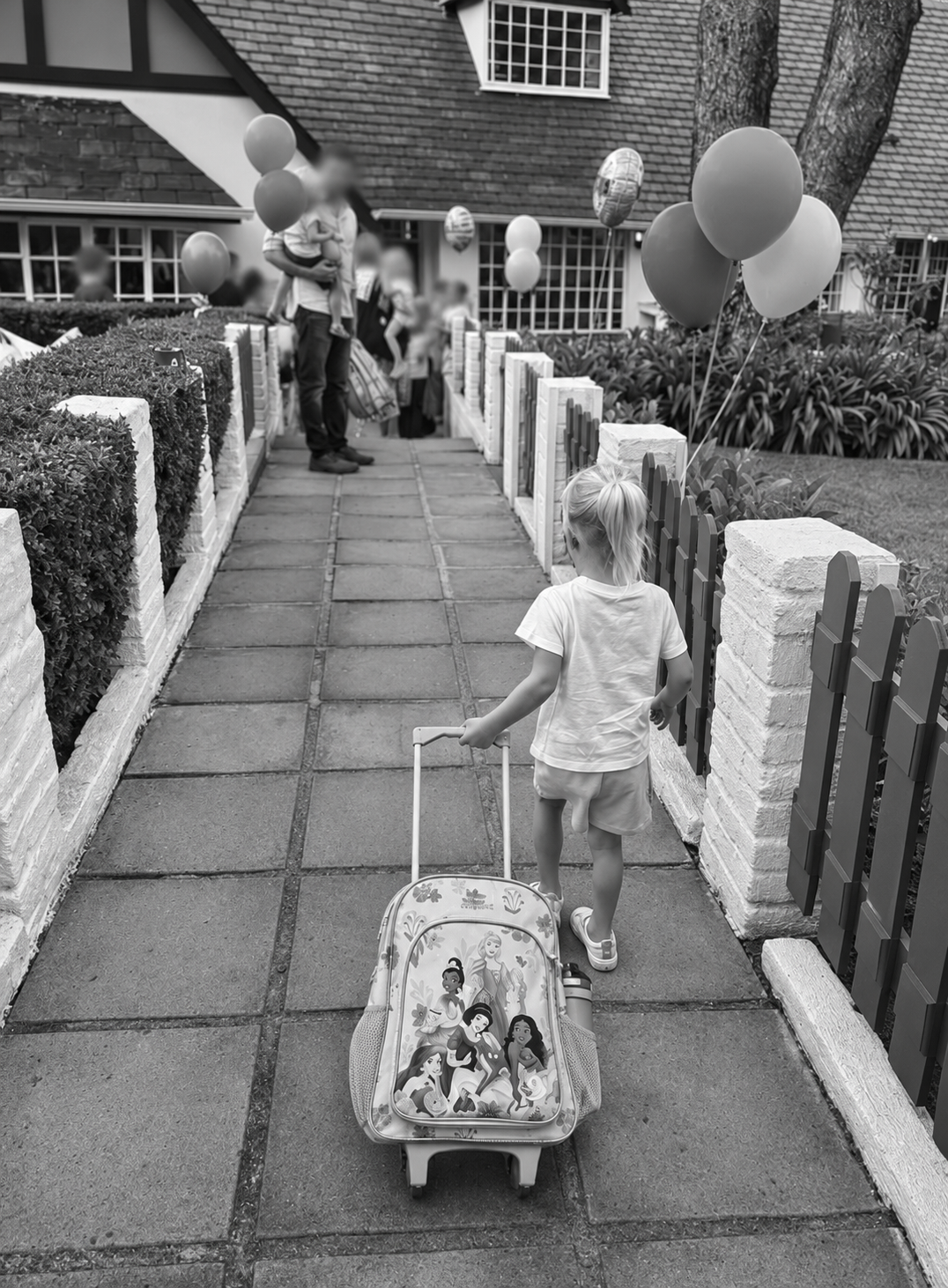
Then I thought about my children moving from nursery school to ‘big’ school. New classrooms, teachers, routines, uniforms, homework and expectations. But they’re still students. They still go to school to learn, make friends, discover things and grow.
We don’t need to convince them to abandon one identity and become a completely different person. The foundation changes, expectations evolve, and we support them in finding their feet.
Yet at work we tell developers to become AI engineers, or infrastructure engineers to adopt entirely new identities as Platform Engineers or DevOps Engineers. We risk turning an evolution of capability into a challenge to professional identity.
A developer using AI is still a developer. An infrastructure engineer using automation is still an engineer. Their methods and responsibilities can evolve substantially without their previous identity becoming worthless. Some roles will genuinely change or disappear, and we must be honest about that. But not every new capability requires an identity crisis.
Perhaps people aren’t resisting changes to how they work. Perhaps they’re resisting being told that who they are is no longer enough.
We forget to say what stays the same.
This was where the thought came together. Children can be anxious about big school. Of course they can: new friends, a teacher, a classroom and unfamiliar routines. But those fears are not necessarily about becoming someone else.
As parents, we explain what will be different. We show them the school and help them understand the unknowns. But we also remind them of what stays familiar: you’re still going to school, still learning, still supported, still coming home at the end of the day.
We don’t just explain what’s changing. We create confidence in what isn’t.
How rarely do we do that at work? Our AI language is almost entirely about disruption: new roles, skills, models, expectations and futures. But people still want meaningful work, competence, belonging, growth and pride in what they accomplish. Organisations still owe people an environment in which they can perform at their best.
The tools may change. The foundations may change. The organisation’s operating system may change. But our commitment to purpose, high performance and enabling people to succeed should remain.
We must distinguish continuity of purpose from continuity of experience. We cannot promise that jobs or responsibilities won’t change when they might. But we can be clear about the principles and commitments that endure.
Maybe leadership during transformation is less about creating excitement for everything that changes, and more about creating confidence in what remains true while helping people navigate what becomes different.
Have we confused managing change with making people change?
Traditional frameworks such as ADKAR name real human needs: awareness, desire, knowledge, ability and reinforcement. But have we confused understanding those needs with prescribing a programme to deliver each one?
Does awareness always require a campaign? Does desire need roadshows? Must knowledge come from mandatory training? Could change instead live in a stand-up, a colleague’s discovery, a manager’s coaching, a platform team’s removal of friction or a retrospective?
Those are moments of change, even when nobody labels them change management. We may be so focused on managing adoption that we’ve forgotten to create the conditions for adaptation. When the capability sits inside the flow of work, people can try it against a real delivery problem, learn from what happens and keep moving. That lets the change effort support delivery rather than compete with it, and may ease some of the pressure to perform adoption.
Maybe we’re measuring the wrong thing.
We count training attendance, use cases, tool usage and adoption milestones. Those can be useful signals, but they don’t necessarily tell us whether work improved.
Someone can complete every milestone and work exactly as before. Someone else may quietly use a new capability, improve their output and help colleagues without ever thinking of themselves as participating in a transformation.
Are people doing better work? Have we removed friction? Are outcomes improving? Are people more capable and confident? The goal isn’t participation in transformation. It’s an organisation that becomes better at evolving. Maybe successful change is the kind where people simply find themselves working in a better way, because we’ve made that better way possible.
So, have we created the monster?
Change is real. It can be disruptive, uncomfortable and personal. People deserve honesty, support and time to learn. Natural adaptation must never become an excuse to abandon them.
But we announce programmes, tell people what to become, set milestones to prove it and communicate endlessly about how different everything will be. Then we wonder why people are anxious.
Perhaps we’ve made the unfamiliar enormous by forgetting to acknowledge the familiar. Perhaps we demand behavioural conformity before providing the capabilities that make it possible. Perhaps we mistake resistance to transformation bureaucracy for resistance to the transformation itself.
I don’t think the answer is to abandon change management. It’s to reconsider what we’re managing: less energy convincing people to change, more energy building the capabilities that let them adapt inside the work; less emphasis on what they must become, more on what they can achieve; less obsession with everything different, more confidence in what remains true.
Helping people learn, grow and perform should be part of everyday leadership, not a special programme every time the world moves forward.
Maybe the monster was never change itself.
I keep coming back to my children moving to big school. They’ll have new teachers, uniforms, routines and expectations. They may be nervous. We’ll help with the unfamiliar. But my hubby and I won’t spend months telling them everything about their lives is about to be transformed.
We’ll remind them they’re still going to school, still there to learn, and still surrounded by people who will help them grow.
We don’t always need to make people excited about everything that’s changing. Sometimes we need to help them feel confident about everything that isn’t.
Maybe adaptation can become part of how we work, rather than a spectacle built around it.
Have we created the monster that is change? Perhaps we have. Not because change is inherently frightening, but because we’ve become so good at telling people how much is changing that we’ve forgotten how much remains.
Maybe the monster isn’t change at all. Maybe it’s everything we’ve built around it.